How easy to get a fake Lund University degree online?
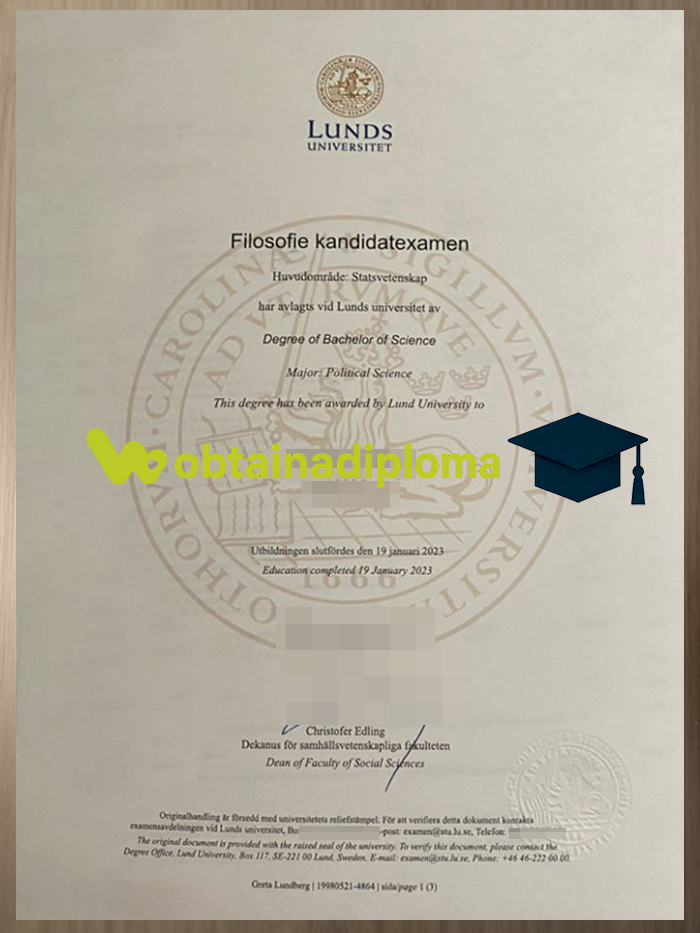
Situated in the charming cobblestone city of Lund in southern Sweden, Lund University stands as one of Scandinavia’s oldest and most prestigious institutions of higher learning. Founded in 1666, the university has evolved from a small provincial academy into a globally renowned research university, consistently ranked among the world’s top 100 institutions.Lund University diploma,Lund University degree,Lund University certificate.With approximately 46,000 students and 8,600 staff, it is today one of Scandinavia’s largest centres for research and education, embodying a unique blend of historical tradition and cutting-edge innovation.
Who can make a realistic Lund University degree certificate online?
The story of Lund University begins in the aftermath of the Treaty of Roskilde in 1658, when the province of Skåne was ceded from Denmark to Sweden. Bishop Peder Winstrup of Lund proposed establishing an academy in the city, recognising that the youth of Skåne could no longer study in enemy territory in Copenhagen. After years of deliberation, the university was formally founded on 19 December 1666 under the regency of Queen Hedvig Eleonora, with the formal inauguration taking place in Lund Cathedral on 28 January 1668—the King’s name day.
The new institution was named Regia Academia Carolina (The Royal Carolingian Academy) and initially comprised four faculties: theology, law, medicine, and philosophy, with fourteen professors and eighty students. Notably, the university had no dedicated premises; most teaching took place in the cathedral until 1688, when the university acquired the King’s House. Among the first lecturers was the renowned Saxon legal scholar Samuel Pufendorf, giving the young academy an international profile from its inception.
The university’s early years were challenging. It was forced to close in 1676 due to a Danish invasion, reopening in 1682 with predominantly Swedish lecturers. The late 17th and early 18th centuries brought further trials, including war, fires, and plague. Yet the university persevered, and as the 18th century progressed, it entered a period of relative stability.College Diploma Replacement
Scientific curiosity flourished, with growing emphasis on “useful” subjects such as science, medicine, and economics. The Triewald collection of scientific instruments was acquired, an astronomical observatory was established, and an anatomical theatre enabled public dissections and physical experiments.
The early 19th century is remembered as a golden age for Lund University. New professorships were established, student numbers increased, and the faculty included celebrated polymaths such as poet Esaias Tegnér, Professor of Greek, and Carl Adolph Agardh, Professor of Botany and Economics.
Agardh was instrumental in founding the Academic Society (AF) in 1830, which became the cultural hub of student life. The construction of the AF Borgen building in 1851 and the completion of the main University building in 1882 marked the university’s growing stature and physical expansion.
A landmark moment came in 1880 when the first female students—Hildegard Björck and Hedda Andersson—were admitted, ending over two centuries of exclusively male education at the academy. However, it was not until