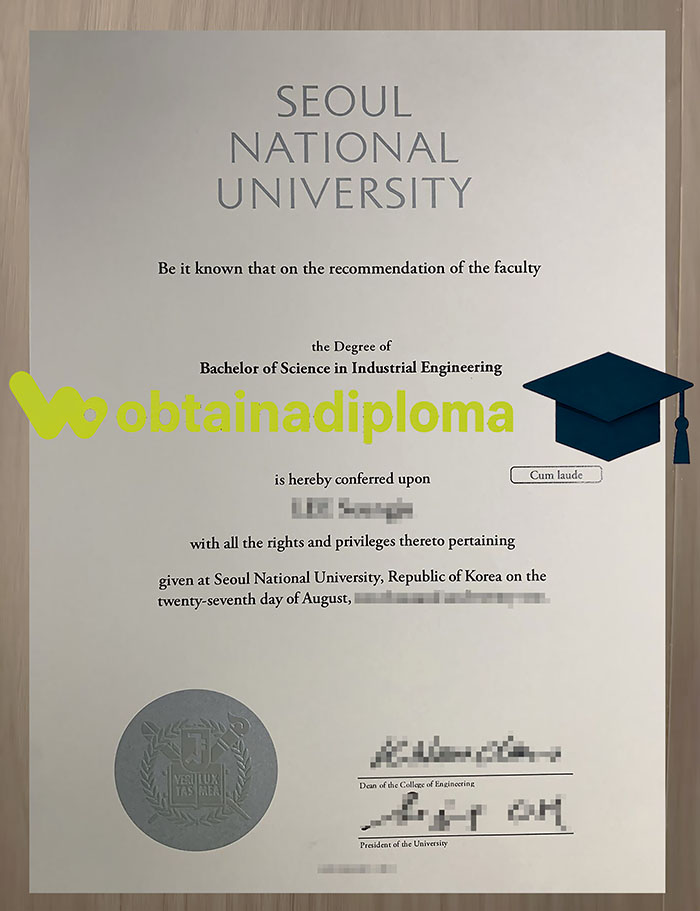
Selling top-quality replica seoul national university certificate online.
Rising from the slopes of Gwanak Mountain on the southern edge of Seoul, a remarkable institution has shaped the course of modern Korean history for nearly eight decades. Seoul National University (SNU) stands today as South Korea’s flagship university—the undisputed crown jewel of the nation’s higher education system and a global powerhouse of research and innovation.seoul national university certificate,.seoul national university diploma,.seoul national university certificate.
How real are thseoul national university certificate we made?
Seoul National University was founded on August 22, 1946, a year after Korea’s liberation from Japanese colonial rule. The university emerged from the merger of ten higher education institutions scattered across the capital—including Gyeongseong University and colleges of law, medicine, engineering, and agriculture. This amalgamation was not merely administrative convenience but a deliberate national project: to create the first comprehensive university of an independent Korea, designed to produce the intellectual elites who would lead a newly liberated country into an uncertain future.
The university’s early years were anything but stable. In June 1950, the Korean War broke out during student registration, forcing the university to operate classes through the Busan Wartime Nations University. Yet even amid destruction, seeds of recovery were being sown. Between 1954 and 1962, the Minnesota Project provided over $9.7 million in financial aid, sending 218 SNU professors to United States universities for training in critical fields including agriculture, engineering, medicine, and public administration.
SNU’s identity has always been inseparable from Korea’s national trajectory. Its members were at the forefront of the democratisation movement—six students were shot by police during the April 19 Revolution in 1960, and later figures like the late Chairman Kim Geun-tae and martyr Park Jong-chul bore witness to the university’s struggle for democracy during authoritarian regimes.
The emergence of the “Gwanak Generation” that broke free from conventional elitism was built on the foundation of these sacrifices.
The physical integration of the university marked another pivotal chapter. From its founding until 1975, SNU was dispersed across multiple campuses in Dongsung-dong, Yeongeon-dong, Jongam-dong, and even Suwon. The government announced a ‘Ten-Year Plan for Integration’ in 1968, and in March 1975, the first entrance ceremony was held at the new Gwanak Campus. This consolidation laid the foundation for SNU to grow into a truly comprehensive university, operating three main campuses today: Gwanak (the main campus), Yeongeon (the medical campus), and Pyeongchang (a bio-technology complex).
Today, SNU’s reputation is backed by formidable statistics. In the QS World University Rankings 2026, SNU holds 38th position globally, while the Times Higher Education World University Rankings 2026 place it 58th worldwide—in both cases, the highest-ranked institution in South Korea. The university ranks 18th globally in academic reputation among Korean institutions, a testament to its standing among peers worldwide.