Where to buy Stanford University fake certificate?
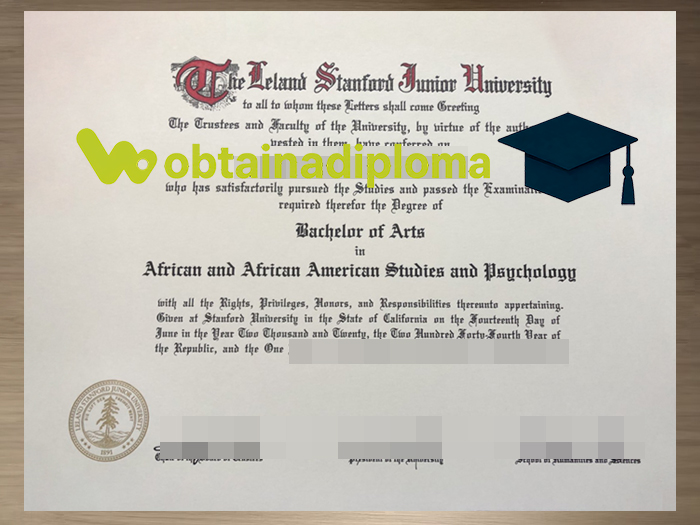
Stanford University is more than just a collection of prestigious academic buildings; it is a living embodiment of an idea.Stanford University diploma,Stanford University degree,Stanford University transcript. Founded in grief, it grew to become the engine of innovation that shaped the modern world and now stands as a global beacon for research, entrepreneurship, and the power of a truly interdisciplinary education.
Steps to order Stanford University certificate online.
A Founding Born of Love and Vision
The story of Stanford begins in 1884, a year marked by tragedy for railroad magnate and former California Governor Leland Stanford and his wife, Jane. Their only child, Leland Stanford Jr., succumbed to typhoid fever at the age of 15 while traveling in Italy . In their profound grief, the Stanfords resolved to create a lasting memorial. They famously declared that “the children of California shall be our children,” and decided to transform their 8,180-acre Palo Alto stock farm into a university .How to get a replica Stanford degree safely.
Leland Stanford Junior University, as it is still legally named, opened its doors on October 1, 1891 . From its inception, the university was radical for its time. It was co-educational and non-sectarian, a deliberate break from the traditions of many established Eastern universities . The founders and the university’s first president, David Starr Jordan, envisioned an institution that would produce “cultured and useful graduates” by combining a classical liberal arts education with practical training in science and engineering . This pragmatic philosophy, rooted in the American West, would prove to be remarkably prescient.
The Campus: The “Farm” That Became a Tech Hub
The university’s main campus in Stanford, California, adjacent to Palo Alto, is affectionately known as “the Farm” in honor of its equestrian origins . It remains one of the largest and most iconic university campuses in the United States . The architectural vision was entrusted to the firm of Shepley, Rutan, and Coolidge, in collaboration with the famed landscape architect Frederick Law Olmsted, who designed New York City’s Central Park . The result is a stunning ensemble of sandstone buildings with distinctive arches, quadrangles, and arcades, creating a campus that is both monumental and inviting.
The university’s unofficial motto, a German phrase, “Die Luft der Freiheit weht” (The wind of freedom blows), has long been its rallying cry . This spirit of freedom and innovation is most visible in Stanford’s relationship with Silicon Valley. The university’s location, less than an hour south of San Francisco in the heart of what would become the global center of technology, was not accidental but cultivated .
The Birth of Silicon Valley
The symbiotic relationship between Stanford and Silicon Valley is one of the most consequential stories in modern economic history. Engineering Professor Frederick Terman, later a dean and provost, is often dubbed the “Father of Silicon Valley” for his visionary encouragement of his students . He urged them not only to develop their ideas but also to commercialize them. In 1939, two of his graduate students, William Hewlett and David Packard, developed the precision audio oscillator in their garage and founded the company that would become HP . This was the spark.
This culture of innovation was formalized in 1951 with the creation of the Stanford Research Park, the world’s first university research park, which housed companies led by such innovators as Varian Associates . Over the decades, Stanford affiliates and alumni have founded countless world-changing companies, generating an estimated annual revenue of more than $2.7 trillion. If these companies were a nation, they would constitute the 10th-largest economy in the world .
The list of companies born from this entrepreneurial crucible is staggering, including Nike, Netflix, Hewlett-Packard, Sun Microsystems, Instagram, Snapchat, PayPal, and Yahoo . Perhaps most famously, it was in a Stanford dorm room that Larry Page and Sergey Brin developed the search engine algorithm that would become Google .