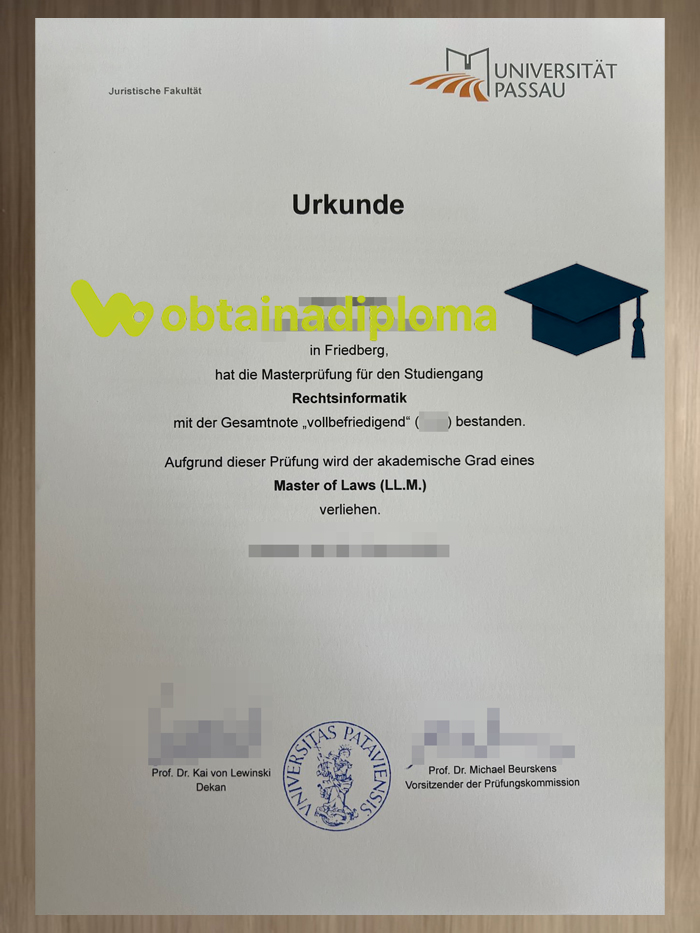
How to order a 100% copy University of Passau urkunde?
Nestled along the banks of the Inn River in Lower Bavaria, the University of Passau represents a distinctive blend of historical depth and forward-thinking academic innovation. Founded in 1973, it is one of Bavaria’s youngest universities—a fact that has afforded it the distinction of housing the most modern campus in the state. University of Passau certificate,University of Passau transcript,University of Passau degree.Yet beneath this contemporary veneer lies an institutional heritage stretching back to 1622, when an Institute for Catholic Studies was first established within a Jesuit Gymnasium founded by Prince Leopold.
How to order the University of Passau fake urkunde?
Today, the University of Passau has evolved into a respected public research institution, home to approximately 10,000 students from over 100 countries, and consistently ranked among the leading 30% of universities worldwide.
The university’s contemporary identity as a centre of interdisciplinary research and teaching is the product of a long and layered institutional evolution. The modern university was formally established on 1 January 1973 by a resolution of the Bavarian State Parliament, but its roots extend much deeper into the region’s intellectual history.
The story begins in 1622 when an Institute for Catholic Studies was incorporated into the existing Gymnasium. In 1773, this institution was elevated to a fürstbischöfliche Akademie, reflecting its close ties to the local bishopric. However, the secularisation of 1803 brought a significant loss of status, downgrading it to a kurfürstliches Lyzeum. The institution experienced a period of abandonment before being re-established as the Passauer Lyzeum, which gradually grew in stature until it became a philosophical-theological university in 1923.
high quality fake urkunde.
The turbulent period of the Nazi regime forced the university to change its logo, a symbolic erasure that was reversed in 1950 with the introduction of a new seal depicting Mary with the Child Jesus vanquishing evil. This strong religious symbolism was ultimately deemed inappropriate for the newly conceived secular university, and a neutral logo was adopted. In 1969, the city council initiated the negotiations that would culminate in the establishment of the modern University of Passau on 1 January 1973.
This decision was not without controversy. In 2010, the Department of Catholic Theology and the Chair of Philosophy were rendered inactive for a planned 15-year period, a move that sparked significant debate given the faculty’s numerous research awards. Today, the Department of Catholic Theology continues to offer Catholic religious education as a specialisation within teacher training programmes and the M.A. in Caritas Science, preserving a residual link to the university’s theological origins within a secular research framework.
The University of Passau’s campus is arguably its most distinctive physical asset. With the exception of the Department of Catholic Theology located in the Old Town and a few administrative offices in the city centre, all faculties are situated on a single campus along a single street—a rarity in Germany that fosters internal communication and interdisciplinary collaboration.